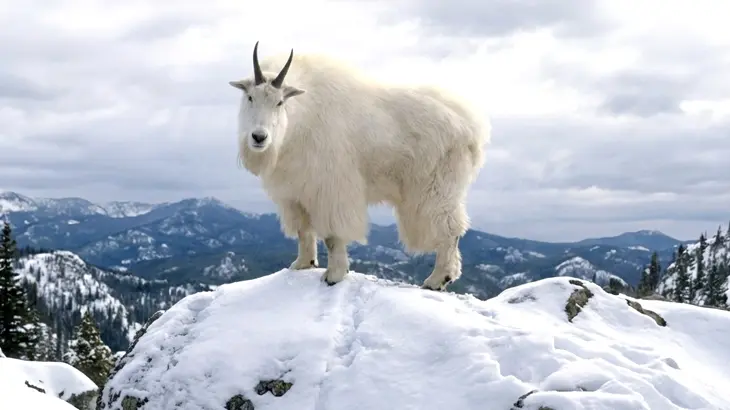
Mountain Goat in December
Introduction
December is one of the most challenging and revealing months in the annual cycle of the Mountain Goat (Oreamnos americanus). As winter fully sets in across alpine and subalpine regions of North America, mountain goats face extreme cold, deep snow, and limited food availability. Their survival during this period highlights some of the most impressive adaptations found among North American big game species.
For hunters, wildlife observers, and mountain naturalists, December offers a unique perspective on mountain goat behavior. While hunting opportunities are highly limited or closed in many jurisdictions due to conservation priorities, understanding how goats move, feed, and survive in mid-winter is essential for ethical management, long-term planning, and appreciating the species’ ecological resilience.
Behavior and Biology in December
Winter Survival Strategies
In December, mountain goats enter a true winter survival mode. They do not migrate long distances but instead shift vertically, moving from high alpine ridges to slightly lower elevations where wind scours snow from cliffs and steep slopes. These areas provide access to exposed vegetation and reduce energy expenditure compared to deep snow basins.
Feeding Behavior
Food availability is extremely limited in December. Mountain goats rely on woody browse, including alpine shrubs, lichens, mosses, sedges, and dried grasses exposed by wind or shallow snow. They often revisit the same feeding sites repeatedly, conserving energy and minimizing unnecessary movement.
Social Structure and Activity Levels
Activity levels drop significantly in December. Mountain goats spend long periods resting to conserve calories, moving primarily during short feeding windows. Groups are typically small, with adult females and juveniles forming loose bands, while mature males remain more solitary after the rut, which usually concludes in late November.
Hunting Activity in December
Seasonal Regulations and Opportunities
December hunting for mountain goats is extremely limited and often closed in most U.S. states and Canadian provinces. Where seasons do exist, they are tightly controlled through limited-entry permits or special draws, reflecting the species’ low reproductive rate and sensitivity to overharvest.
Methods and Ethical Considerations
In jurisdictions where December hunting is permitted, spot-and-stalk remains the primary legal method. Snow cover can improve visibility, but harsh weather, avalanche risk, and steep terrain dramatically increase danger. Ethical considerations are paramount: hunters must prioritize safe shot placement and recovery, as wounded animals in winter conditions have minimal survival chances.
Equipment and Preparation
December hunts require specialized cold-weather gear, mountaineering equipment, avalanche safety tools, and exceptional physical conditioning. Many experienced hunters avoid winter pursuits altogether, recognizing the high risk to both human safety and the resource.
Ecological Role in December
Even in the depths of winter, mountain goats play a crucial ecological role. Their selective browsing influences alpine vegetation structure, preventing woody plant dominance in exposed areas. By concentrating activity on wind-scoured slopes, they contribute to nutrient cycling in otherwise dormant ecosystems.
Mountain goats also serve as prey for apex predators such as wolves, cougars, and occasionally bears in milder regions. Winter predation pressures help maintain healthy population dynamics, particularly by removing weaker individuals.
Regional Differences Across North America
Pacific Northwest and Coastal Ranges
In coastal regions of Washington, British Columbia, and Southeast Alaska, December conditions are cold but often wetter than interior ranges. Heavy snow combined with ice can push goats to extremely steep, rocky terrain, increasing fall mortality but also reducing predator access.
Rocky Mountains
In the Northern Rockies, December brings deep snow and severe cold. Mountain goats remain at high elevations where wind exposure keeps slopes partially clear. Human access is minimal, making this period one of relative isolation for most herds.
Interior Alaska and Northern Canada
Far northern populations experience extreme cold and prolonged darkness. Activity levels are very low, and survival depends heavily on fat reserves accumulated during summer and fall.
Practical Notes for Hunters and Naturalists
Observation Tips
For wildlife observers, December is an excellent time to study mountain goat winter habitat selection from a distance using spotting scopes. Look for wind-blown ridges and cliff bands rather than valley bottoms.
Safety Considerations
Anyone traveling in mountain goat country in December should be trained in avalanche awareness and winter survival. Even non-hunters should avoid disturbing goats, as forcing unnecessary movement can significantly impact their energy reserves.
Conservation Awareness
Understanding winter behavior reinforces why conservative hunting seasons and habitat protection are critical. Mountain goats are highly specialized and slow to recover from population declines, making winter protection especially important.
Quick Reference Table
| Aspect | Details |
|---|---|
| Species | Mountain Goat (Oreamnos americanus) |
| Month | December |
| Primary Behavior | Winter survival, reduced movement, vertical habitat shifts |
| Hunting Activity | Highly restricted or closed in most regions |
| Typical Hunting Season | Late summer to fall (region-dependent) |
| Key Regions | Rocky Mountains, Pacific Northwest, Alaska, Northern Canada |