

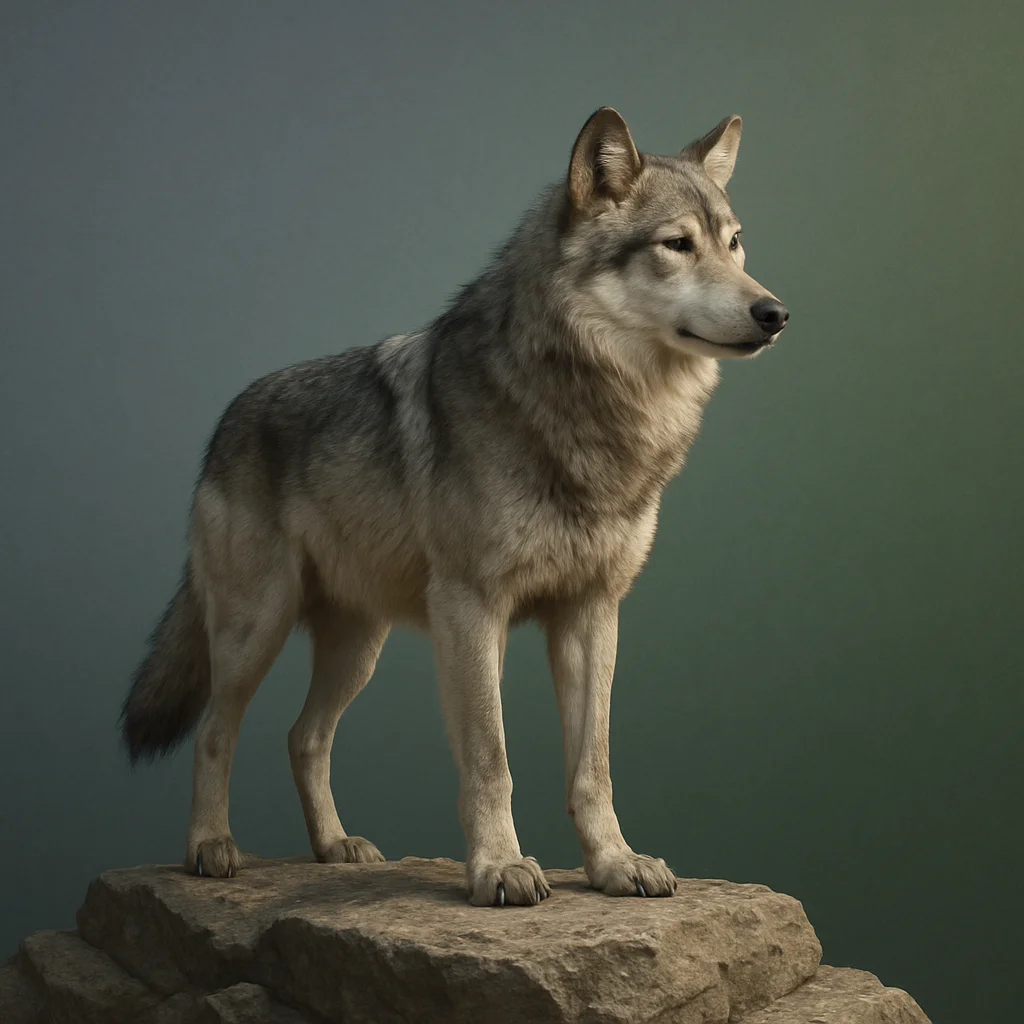
Wolf, or gray wolf, or common wolf (lat. Canis lupus) is a predatory mammal of the canine family. Together with the coyote (Canis latrans) and the jackal (Canis aureus), it makes up a small genus of wolves (Canis). In addition, as shown by the results of studying the DNA sequence and genetic drift, it is a direct ancestor of the domestic dog, which is usually considered a subspecies of the wolf (C.l.familiaris). The wolf is the largest animal in its family: its body length (with tail) can reach 160 cm, height at the withers up to 90 cm; body weight up to 62 kg.
The wolf was once much more widespread in Eurasia and North America. Nowadays, its range and total number of animals have noticeably decreased, mainly as a result of human activity: changes in natural landscapes, urbanization and mass extermination. In many regions of the world, the wolf is on the verge of complete extinction, although in the north of the continents its population still remains stable. Despite the fact that the wolf population continues to decrease, it is still an object of hunting in many places as a potential danger to humans and livestock, or for fun.
As one of the key predators, wolves play a very important role in the balance of ecosystems of such biomes as temperate forests, taiga, tundra, mountain systems and steppes. In total, there are approximately 32 subspecies of wolf, differing in size and shades of fur. The most common wolves in the Russian Federation are the common (C.l.lupus) and tundra (C.l.albus) wolves.
Description
Appearance
The size and total weight of wolves are subject to strong geographical variability; it has been noted that they change proportionally depending on the surrounding climate and in full accordance with Bergman’s rule (the colder the climate, the larger the animal). In general, the height of animals at the withers fluctuates between 60-85 cm, length 105-160 cm, and weight 32-62 kg, which makes the common wolf one of the largest mammals in the family. In rare cases, in the northern part of North America, individual specimens can weigh more than 77 kg, and the largest animal was recorded in 1939 in Alaska: its weight was about 80 kg. The smallest subspecies is considered to be the Arabian wolf (C.l. arabs), whose females in adulthood can weigh only 10 kg. Within one population, males are always larger than females by about 20%, and with a more forehead-like head.
In general appearance, the wolf resembles a large dog with pointed ears. The legs are high, strong; the paw is larger and more elongated than a dog’s, the length of the track is about 15 cm, the width is 7 cm, the middle two toes are extended forward, which makes it possible to distinguish wolf tracks from dog tracks. The head is broad-browed, the muzzle is relatively wide, strongly elongated and framed on the sides by “sideburns”. The massive muzzle of the wolf distinguishes it well from the jackal and coyote, which have a narrower and sharper muzzle. In addition, it is very expressive: scientists distinguish more than 10 facial expressions: anger, malice, submission, affection, joy, alertness, threat, calm, fear.
The skull is large, massive, high. The nasal opening is wide, especially noticeably widening downwards. The greatest length of the skull of males is 268-285, females 251-268, condylobasal length of the skull, males 250-262, females 230-247, zygomatic width of males 147-160, females 136-159, interorbital width of males 84-90, females 78-85, length of the upper row of teeth of males 108-116, females 100-112 mm.
The structure of the wolf’s teeth is an important characteristic that determines the lifestyle of this predator. On the upper jaw there are 6 incisors, 2 canines, 8 premolars and 4 molars. The lower jaw contains 2 more molars. The fourth upper premolars and the first lower molars are the carnivorous teeth, which play a major role in cutting up game. The canines, which the predator uses to hold and drag its prey, also play an important role. The wolf’s teeth can withstand a load of more than 10 megapascals and are both its main weapon and means of defense. Their loss is fatal for the wolf and leads to hunger and loss of ability to work.
The tail is quite long, thick and, unlike a dog’s, is always lowered; hunters call it a “log”. The tail is the expressive “tongue” of the wolf. Its position and movement can be used to judge the mood of the wolf, whether it is calm or afraid, its position in the pack.
Wolves have thick, rather long fur and consist of two layers, which is why the animal sometimes looks larger than it actually is. The first layer of fur consists of stiff guard hairs that repel water and dirt. The second layer, called the undercoat, contains waterproof down that keeps the animal warm. In late spring or early summer, the down fluff peels off the body in clumps (molting), and the animals rub against rocks or tree branches to facilitate this process.
There are significant differences in color between wolf subspecies, often in accordance with the environment. Forest wolves are gray-brown. Tundra wolves are light, almost white. Desert wolves are grayish-reddish. In the highlands of Central Asia, wolves have a bright ocher color. In addition, there are pure white, red or almost black individuals. Wolf cubs have a uniform, dark color that lightens with age, and the blue iris of the eyes usually becomes golden-yellow or orange after 8-16 weeks of life. In rare cases, wolves’ eyes remain blue throughout life. Within a single population, the color of the coat can also vary among individuals or have mixed shades. The differences are only in the outer coat; the undercoat is always grey. It is often believed that the colour of the coat is intended to blend the animal with the environment, i.e. it serves as camouflage; however, this is not entirely true: some scientists point out that mixed colours enhance the individuality of a particular individual.
Voice
The variety and frequency range of wolves’ vocal means significantly exceeds the capabilities of the vast majority of animals (except humans and bats). Wolves make sounds such as howling, whining, whining, growling, growling, yapping, and barking. Each sound has a huge number of variations.
Wolves react consciously to these sounds. With the help of their voice, wolves can convey very complex messages – about the presence of a certain animal in a certain place. Thus, researcher Farley Mowat observed in the Canadian tundra how wolves transmitted information over long distances along a chain that the expected caribou had moved south and were located there. In this case, the wolf first listens to the information coming from another wolf, which may be eight kilometers away. Then the transmitter throws its head back and howls with a vibrating howl: at first low, but ending at the highest note still perceptible to human hearing. Checking the wolf’s message about the location of the caribou confirmed this case. Wolves can also inform each other about the appearance of people.
The signal to attack for wolves is a battle cry given by the leader of the pack. This sound is similar to the growl of an enraged dog rushing at a person.
Wolves howl at dawn or dusk, but not every day. The howl begins with a solo howl of the leader, which differs significantly from the howls of other members of the pack. They join in a little later. The choral howl usually ends with a yapping, shrill bark.
The collective vocal creativity of the pack is a sign of social life. Wolves’ passion for it has an emotional basis and sharpens the feeling of belonging to the pack. It is also a means of communication with other packs and stray brothers.
Some people are able to understand the sound messages that wolves exchange; such was the Eskimo Utek, who was met in the Canadian tundra by F. Mowat.
Adaptations
In the course of evolution, wolves have developed a number of physiological characteristics that allow them to travel long distances in search of food. This is facilitated by a narrow, streamlined chest, a sloping back and strong legs. They can easily run a distance of several kilometers at a trot at a speed of 10 km/h, and during a chase they can easily reach a speed of 65 km/h, while jumping up to 5 m. The structure of the animals’ paws allows them to feel free in various landscapes, including deep snow. There are small membranes between the toes, due to which the specific load on the surface is reduced, and predators are able to move through the snow much faster than their victims. Another feature of the structure of the paws is that wolves do not rely on the entire foot when moving, but only on the toes, that is, they are “digitigrade” – this method of movement helps them balance their weight. The front paws are larger than the back ones and have an additional (fifth) rudimentary finger on the inside of the metatarsus. Bristly fur and blunt claws help maintain balance on slippery surfaces, and special blood vessels protect the paws from hypothermia. Scent glands located on the paws between the toes leave identification marks behind the animal, which on the one hand facilitate orientation in the area, and on the other inform other wolves about the leader’s movements. Another feature that helps animals survive in harsh winter conditions is the low thermal conductivity of the fur (1.2-1.5 times lower than the thermal conductivity of muskrat and beaver skins).
Wolf distribution
Habitat
In historical times, the range of wolf was second only to humans in area among land mammals, covering most of Scandinavia, the Balkans, and the Baltics. In Asia, it inhabits Korea, parts of China and the Hindustan Peninsula, Georgia, Azerbaijan, Kazakhstan, Afghanistan, Iran, Iraq, and the north of the Arabian Peninsula; it is extinct in Japan (subspecies Canis lupus hodophilax). In North America, it is found from Alaska to Mexico. In Russia, it is absent only on some islands (Sakhalin, Kuril Islands).
Habitat
The wolf inhabits a wide variety of landscapes, but prefers steppes, semi-deserts, tundra, forest-steppe, avoiding dense forests. In the mountains, it is widespread from the foothills to the alpine meadows, adhering to open, slightly rugged areas. It can settle near human habitation. In the taiga zone, it spread following humans, as the taiga was cut down.
The wolf is a fairly territorial creature. Breeding pairs, and often packs, live sedentary in certain areas, the boundaries of which are indicated by odorous marks. The diameter of the area occupied by a pack in winter is usually 30-60 kilometers. In spring and summer, when the pack breaks up, the territory it occupies is divided into several fragments. The best of them is captured and held by the main pair, the remaining wolves switch to a semi-nomadic lifestyle. In the open steppes and tundra, wolves often migrate following moving herds of livestock or domestic reindeer.
Den sites are arranged for breeding offspring; Usually they use natural shelters – crevices in rocks, thickets of bushes, etc. Sometimes wolves occupy burrows of badgers, marmots, arctic foxes and other animals, less often they dig them themselves. The female is most attached to the den during the period of raising offspring, the male does not use it. The young are hatched in sheltered places: in the forest belt – mainly in dense bushes, on ridges among marshy swamps; in the steppes – in ravines, gullies and dry reed thickets near lakes overgrown with bushes; in the tundra – on hills. It is characteristic that wolves never hunt near their home, but at a distance of 7-10 km and further. After the cubs grow up, the animals stop using a permanent den and settle down to rest in different, but reliable places.
Lifestyle and nutrition
The wolf is a typical predator, obtaining food by actively searching for and pursuing victims.
The basis of the wolf’s diet is ungulates: in the tundra – reindeer; in the forest zone – moose, deer, roe deer, boars; in the steppes and deserts — antelopes. Wolves also attack domestic animals (sheep, cows, horses), including dogs. They also catch smaller prey, especially solitary wolves: hares, gophers, mouse -like rodents. In summer, wolves do not miss the opportunity to eat a clutch of eggs, chicks, grouse sitting on nests or feeding on the ground, waterfowl and other birds. They often get domestic geese. Foxes, raccoon dogs, corsacs sometimes become prey for wolves; Occasionally, hungry wolves attack sleeping bears in their dens. Wolves are prone to cannibalism. There are many known cases of them tearing apart and eating weakened animals, wounded by hunters, or seriously injured in a fight during the rutting season. Unlike many other predators, wolves often return to the uneaten remains of their prey, especially during the hungry season. They do not disdain the corpses of livestock, and on the sea coast – the carcasses of seals and other sea animals washed up on the shore. During periods of food shortage, wolves eat reptiles, frogs, and even large insects (beetles, locusts). Wolves, especially in the southern regions, also eat plant foods – various berries, wild and garden fruits, even mushrooms. In the steppes, they often raid watermelon and melon fields, satisfying not so much hunger as thirst, since they need regular, abundant watering.
They are active mainly at night. Wolves often make their presence known with a loud howl, which is very different in seasoned males, she-wolves and young animals. Of the external senses, the wolf has the best developed hearing, a little worse – smell; vision is much weaker. Well-developed higher nervous activity in wolves is combined with strength, agility, speed and other physical characteristics that increase the chances of this predator in the struggle for existence. If necessary, a wolf can reach speeds of up to 55-60 km/h and can cover distances of up to 60-80 km per night. It can reach a gallop in a few seconds, covering 4 meters (cases of a wolf attacking a person).
The wolf is highly developed mentally. This is expressed in the ability to navigate the environment and escape from danger, as well as in hunting methods. There are known cases when a pack of wolves split up, and one part remained in ambush, while the other drove the prey onto it. In a pack pursuing an elk or deer, some wolves often run on the heels of the victim, while others intercept it or trot slowly and, having rested, replace the vanguard until they exhaust the victim.
Social behavior and reproduction of wolves
Wolves are monogamous, that is, there is one female for every male. In addition, wolves typically lead a family lifestyle: they live in packs of 3 to 40 individuals — family groups consisting of a pair of leaders — an alpha male and an alpha female, their relatives, and visiting lone wolves. Pairs form for an indefinitely long period — until one of the partners dies. Within the pack, there is a strictly defined hierarchy, with the dominant pair at the top, followed by adult family members, lone wolves, and finally the puppies of the last litter. As a rule, instinct forces predators to look for a partner and a territory for reproduction outside their pack. The dispersion of sexually mature animals occurs all year round, and puppies from the same litter usually do not mate together. Sexual maturity occurs in the third or fourth year of life.
Mating season
With the onset of the mating season, which, depending on the latitude, falls on January — April, tension increases in the pack: the male and female of the dominant pair aggressively guard their partner from other members of the pack, and a group of males gathers around young and single old she-wolves, between whom fierce fights arise, sometimes with a fatal outcome. As soon as a new pair is formed, the male and female begin to search for a place for future conception and breeding of offspring. During this period, before the onset of estrus, the male and female court each other in every possible way, stick together and flirt with each other. Under normal conditions, a pack produces only one offspring per season, with the parents of the puppies being the pair of leaders. When the alpha female enters estrus (which happens once a year and lasts 5-14 days), she and her partner leave the pack, retire and mate. The male learns that the female is in estrus by the smell of pheromones secreted in the female’s urine. With the onset of estrus, the female is insensitive to mating for several days, and mating occurs only with the onset of ovulation.
Wolf Reproduction
After 62-65 days of pregnancy, females give birth to 3 to 10-13 blind wolf cubs, which regain their sight on the 12-13th day. Grown-up wolf cubs are fed by their parents with regurgitated meat, and later with killed prey. The entire pack takes part in feeding the cubs.
By the end of summer, young (newborn) wolves begin to take part in hunts with adults. At this time, wolf cubs born the previous year (old-yearlings) and driven away for the breeding season join the family. The pack stays together until the onset of estrus, when former old-yearlings take part in breeding, and new-born wolves are temporarily driven away. A wolf pack in the autumn-winter season can consist of two old animals, 3-6 new-borns and 2-4 old-yearlings, that is, 7-12 individuals, rarely more.
Although wolves carefully care for their offspring, up to 60-80% of puppies die in the first year of life. Female wolves reach sexual maturity in the second year of life, and males – at 3 years. In the wild, wolves live up to 15 years, but already at 10-12 years they show signs of old age.
Unlike domestic animals, which have estrus twice a year, wolves have 1 estrus per year. This period is correlated with the time of year so that wolf cubs are born in the warm spring, when there is enough food. Before the onset of estrus, the female will not accept the sexual advances of the male.
Economic importance of the wolf
The wolf harms livestock farming and hunting, but on the other hand, it plays an important role in the ecosystem, controlling the number of animals and destroying weak and sick individuals. Wolf hunting is carried out all year round and without special permits. This is done with the aim of reducing the population of the animal, which is harmful to livestock farming.
By crossing some breeds of dogs and wolves, new breeds were created, such as: the Saarloos wolfdog or wolfdog.
Hunting Information
For a full archive of Wolf hunting posts by month, visit the
Gray Wolf Category.